• Episode 3: Kennedy Doubles Down

    Kennedy invests in a military solution to a political question:  What type of government will rule a united Vietnam?

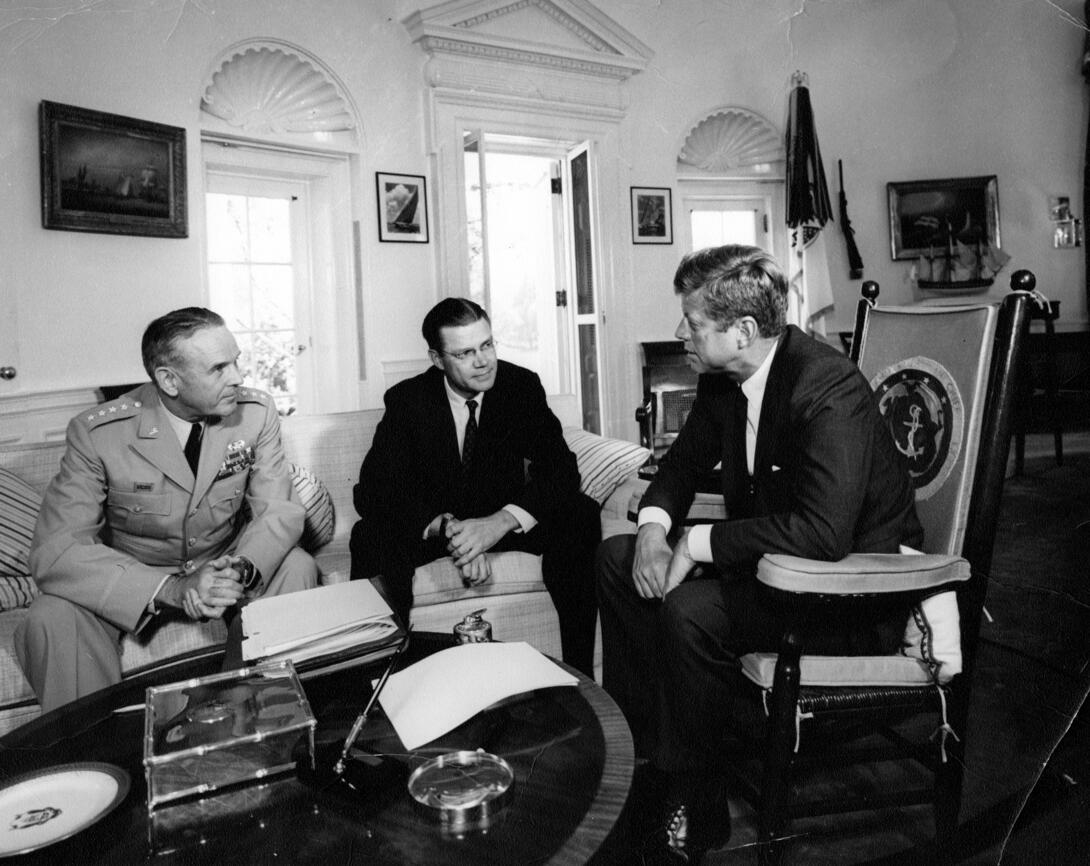
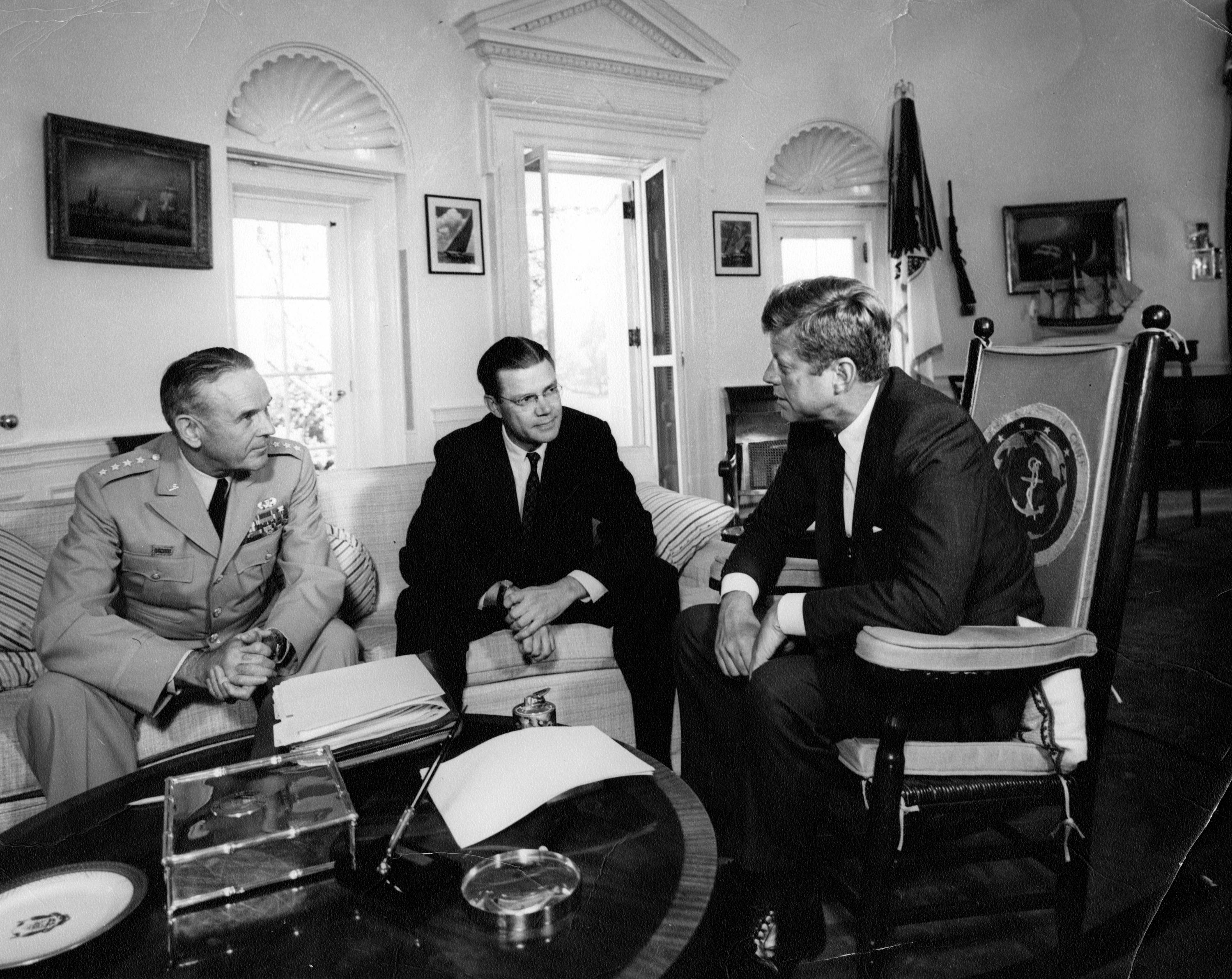
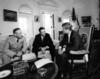
    Black and white photograph of three men in the oval office
  • Now we have a problem in making our power credible and Vietnam is the place. -President John F. Kennedy, 1961

    After the Bay of Pigs defeat in Cuba and the erection of the Berlin Wall, President Kennedy needed a win. “Vietnam is the place,” he told a reporter, convinced the U.S. could restore its Cold War credibility by saving the remote Southeast Asia country from communism.

    Kennedy supplied thousands of additional military advisers and equipment to South Vietnam to fight the Communist insurgency. He resisted sending ground troops, against his advisers’ persistent urging.

    For a time, American assistance appeared to help stabilize South Vietnam—but in 1963 tensions between the Diem regime and its U.S. ally and resistance from the population escalated to a tragic and bloody climax.

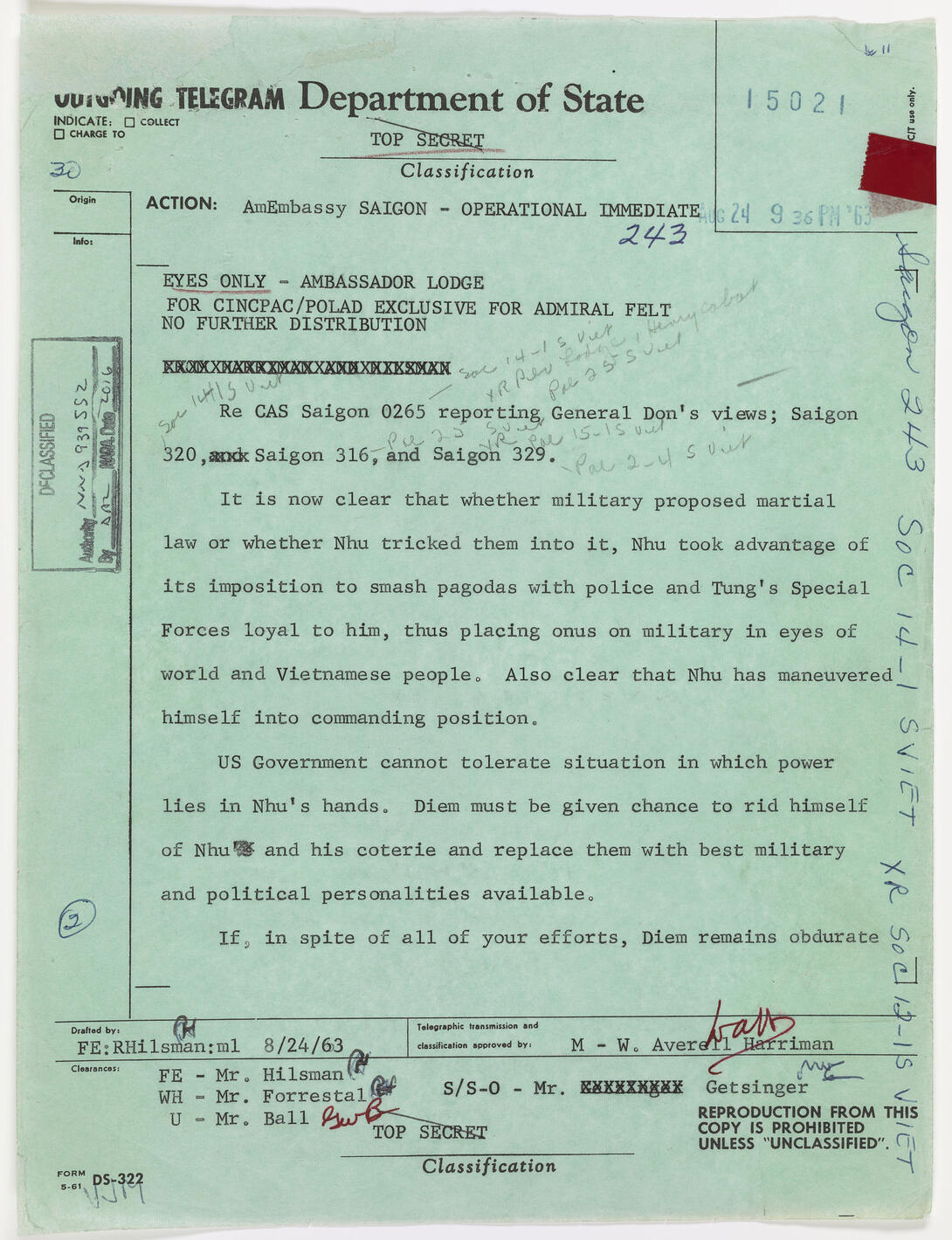
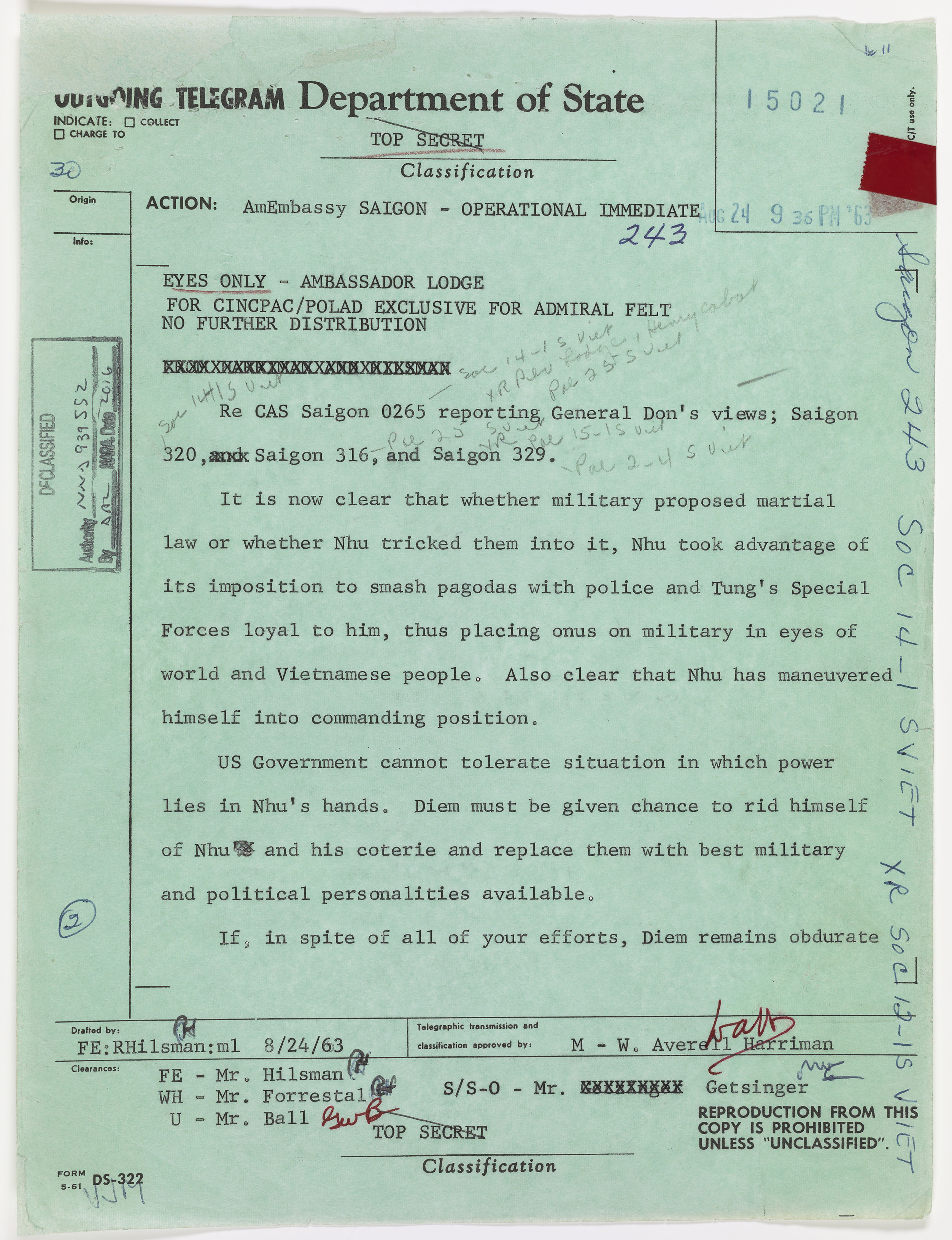
  • Soon after the deadly midnight attacks on Buddhist pagodas, Ambassador Henry Cabot Lodge received this cable. It authorized him to green light a plot to overthrow President Diem.

    Cable 243, August 23, 1963. General Records of the Department of State

  • Key Dates

    April 17–19, 1961: U.S. supports Cuban invasion of the Bay of Pigs

    August 13, 1961: Berlin Wall is erected

    February 8, 1962: U.S. establishes Military Assistance Command Vietnam

    October 14, 1962: Cuban Missile Crisis erupts

    January 2, 1963: Battle of Ap Bac begins

    August 21, 1963: Government forces crackdown on Buddhist protests in brutal Pagoda Raids

    November 1, 1963: Diem is overthrown in a military coup and he and his brother are assassinated the next day

    November 22, 1963: Kennedy is assassinated

    Kennedy, McNamara, and Taylor in the Oval Office at the White House, October 2, 1963. John F. Kennedy Presidential Library and Museum

    https://www.jfklibrary.org/asset-viewer/archives/jfkwhp-1963-10-02-c#?image_identifier=JFKWHP-AR8153-A
  • Diem’s downfall

    The South Vietnamese President’s  increasingly authoritarian regime ends in a violent coup

    The flood of American resources appeared to buoy South Vietnam. But in January 1963 a few hundred “Viet Cong” guerrillas repelled the assault of 2,500 American-equipped South Vietnamese infantrymen in the Battle of Ap Bac. The American press portrayed it as evidence that the South Vietnamese military was incompetent and that President Diem was to blame.

    That spring, newspaper images of monks burning themselves in protest against the Diem regime stunned observers around the world. The violence and unrest in Saigon raised blood pressures in Washington. Meanwhile, Diem ignored the Kennedy administration’s increasingly adamant calls for reform.

    The Diem experiment came to a bloody end when he and his brother were assassinated on November 23 in the back of an armored personnel carrier.

  • Black and white photograph of three men in the oval office
  • Blue document with black typewritten text, red notations, and words "Top Secret" crossed through at top.
    Black and white photograph of three men in the oval office
DownloadShow Transcript