General Order No. 3, June 19, 1865
Celebrating Juneteenth
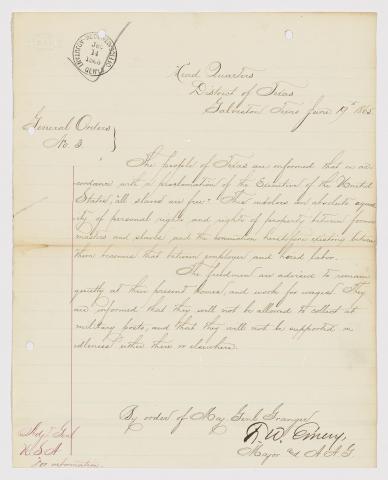
National Archives, Records of the Adjutant General’s Office, 1780s–1917
The Juneteenth holiday celebrates the end of slavery in the United States. It combines the words “June” and “nineteenth,” the historic day that the U.S. Army marched into Texas and secured the freedom of the last 250,000 Americans to learn of their emancipation.
During the Civil War, President Abraham Lincoln issued the Emancipation Proclamation to end slavery in the states in rebellion against the U.S. in 1863. Given Texas’s geography as the westernmost Confederate state and its small Union Army presence, enslavers in Texas ignored the Emancipation Proclamation for over two years, even after the war had ended.
On the morning of June 19, 1865, the U.S. Army arrived in Galveston, Texas, and delivered General Order No. 3, informing the people of Texas that “all slaves are free.” Six months later, the 13th Amendment abolished slavery nationwide. Every year since, Juneteenth has been celebrated with family gatherings, parades, festivals, and civic engagement. In 2021, Juneteenth was recognized as a federal holiday.
What does General Order No. 3 say?
“The people of Texas are informed that in accordance with a proclamation of the Executive of the United States, ‘all slaves are free.’ This involves an absolute equality of personal rights and rights of property between former masters and slaves and the connection heretofore existing between them becomes that between employer and hired labor.
The freedmen are advised to remain quietly at their present homes, and work for wages. They are informed that they will not be allowed to collect at military posts, and that they will not be supported in idleness either there or elsewhere.”
Related Online Resources
- Juneteenth: The First Commemoration of Abolition
- Find resources related to African American History at Archives.gov.
- Emancipation Proclamation and DC Emancipation Exhibits Celebrate Freedom National Archives News story
- National Archives Safeguards Original ‘Juneteenth’ General Order National Archives News story
- The ‘EP’ at the National Archives Pieces of History blog on the Emancipation Proclamation’s fabled history
- Visitors Get a Rare Opportunity To See the Emancipation Proclamation National Archives News story
- “The Meaning and Making of Emancipation,” a free National Archives eBook
- Rediscovering Black History, a National Archives blog
- Records of the Freedmen’s Bureau, established by Congress to help former Black slaves and poor Whites in the South in the aftermath of the Civil War. Read an article about efforts to preserve and digitize this collection.