Great Seal of the United States
On July 4, 1776, just hours after adopting the Declaration of Independence, the Continental Congress tasked Benjamin Franklin, Thomas Jefferson, and John Adams with creating a national seal. As members of the First Great Seal Committee, each man proposed designs for a national emblem that reflected the independence and aspirations of the new nation. The task proved difficult, and ultimately it took more than three committees and six years to complete the final design for the Great Seal of the United States.
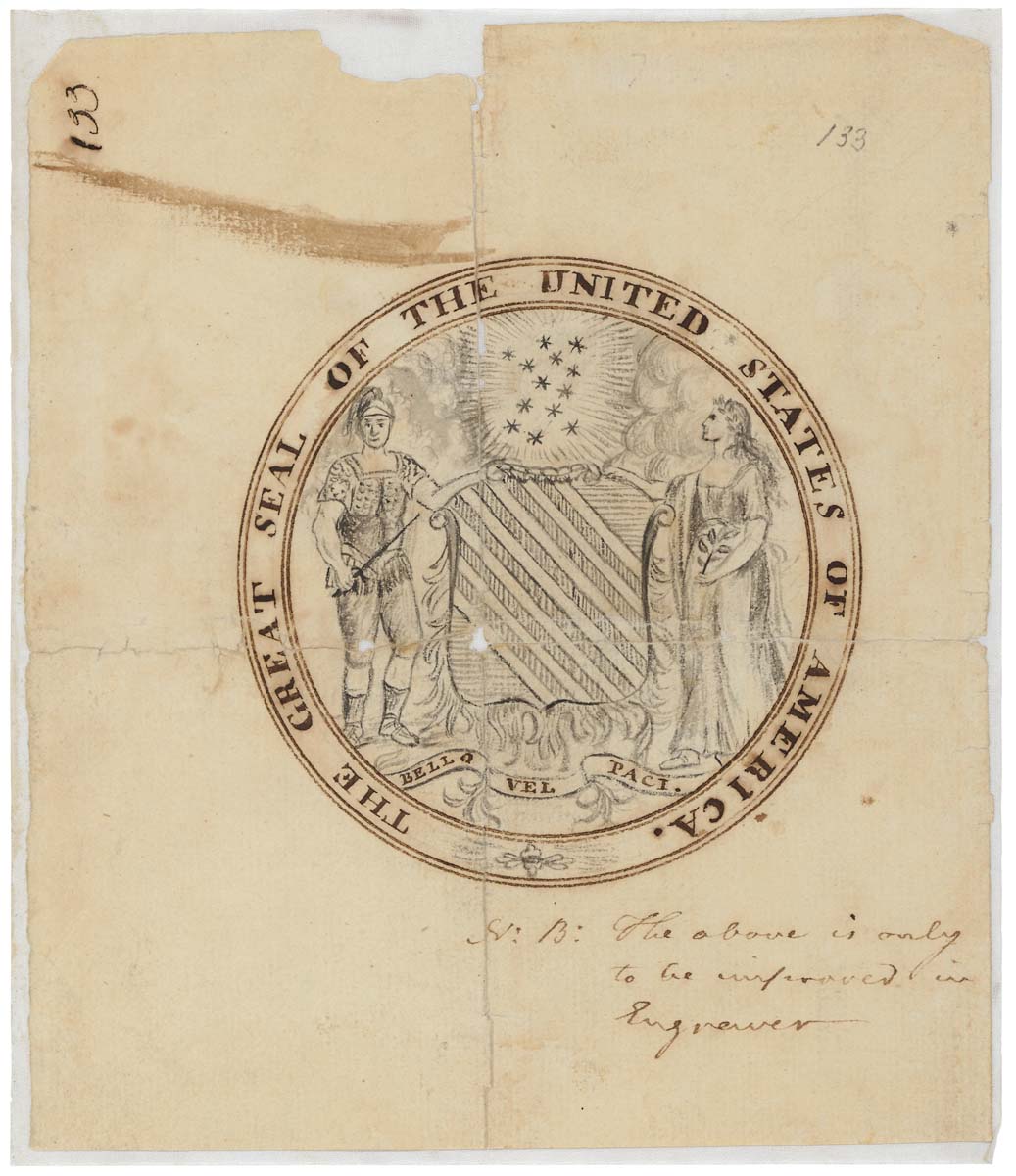
In 1780, Congress appointed a second committee to address the challenge of the Great Seal. It included delegates James Lovell (MA), John Morin Scott (NY), and William Churchill Houston (NJ). They consulted Francis Hopkinson, designer of the American flag and a signer of the Declaration of Independence. Hopkinson’s contributions to the final design included 13 red and white stripes on the shield, a constellation of 13 stars, 13 arrows, and an olive branch—all on the front of the seal.
Francis Hopkinson’s Design for the obverse of the Great Seal of the United States, 1780. Records of the Continental and Confederation Congresses and the Constitutional Convention, National Archives
In 1780, Congress appointed a second committee to address the challenge of the Great Seal. It included delegates James Lovell (MA), John Morin Scott (NY), and William Churchill Houston (NJ). They consulted Francis Hopkinson, designer of the American flag and a signer of the Declaration of Independence. Hopkinson’s contributions to the final design included 13 red and white stripes on the shield, a constellation of 13 stars, 13 arrows, and an olive branch—all on the front of the seal.
Francis Hopkinson’s Design for the obverse of the Great Seal of the United States, 1780. Records of the Continental and Confederation Congresses and the Constitutional Convention, National Archives
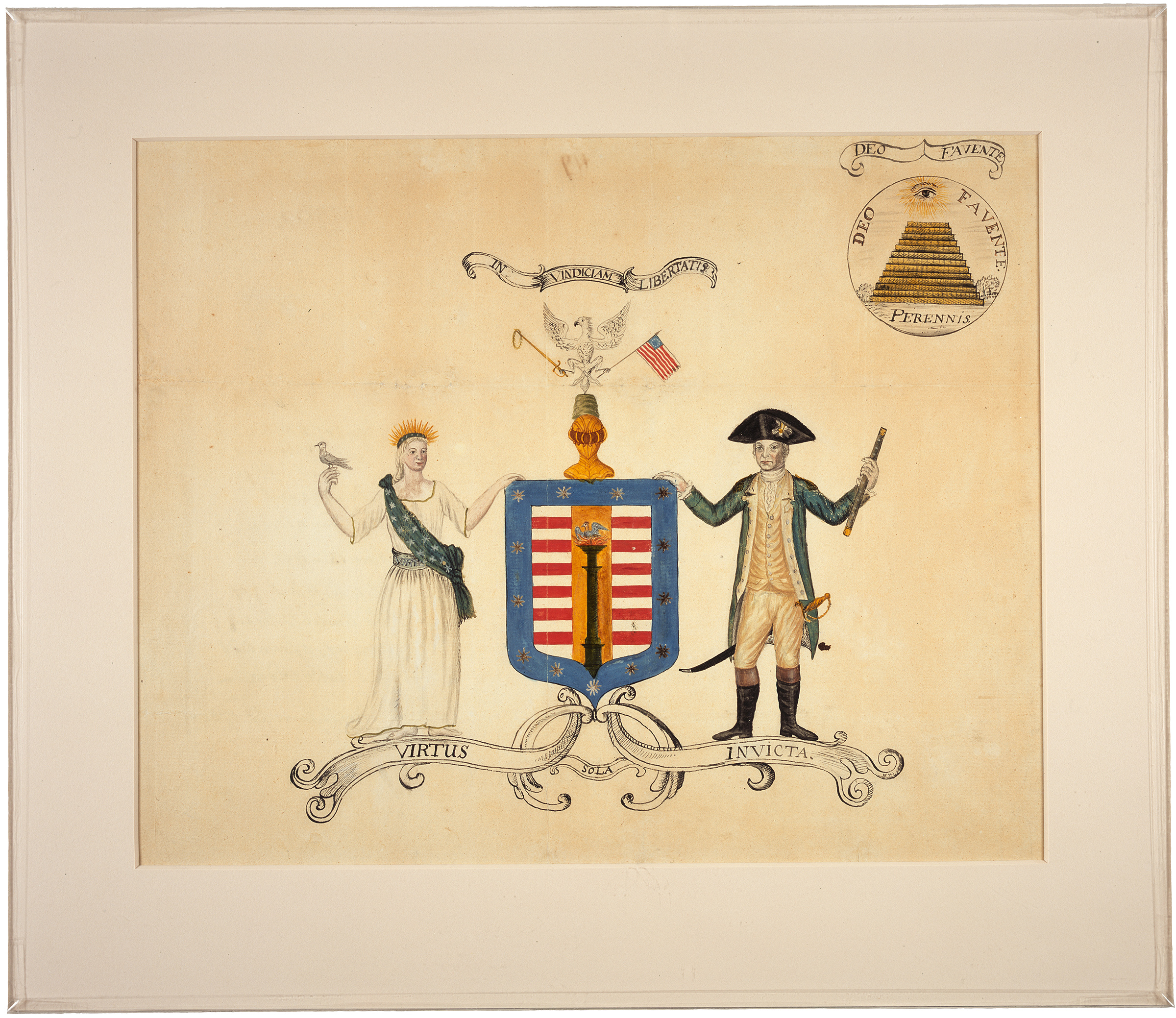
In May 1782, Congress created a third committee to design the Great Seal. The committee consisted of delegates Arthur Middleton (SC), Edward Rutledge (SC), and Elias Boudinot (NY). The committee asked William Barton, a Philadelphia student of heraldry, to assist with the design. Barton’s design included 13 vertical stripes, an eagle, and an olive branch with arrows to symbolize peace and war. He was the first to include the eagle in the design. The reverse featured a 13-step unfinished pyramid topped with the Eye of Providence.
William Barton’s Design for the Great Seal of the United States, 1782. Records of the Continental and Confederation Congresses and the Constitutional Convention, National Archives
In May 1782, Congress created a third committee to design the Great Seal. The committee consisted of delegates Arthur Middleton (SC), Edward Rutledge (SC), and Elias Boudinot (NY). The committee asked William Barton, a Philadelphia student of heraldry, to assist with the design. Barton’s design included 13 vertical stripes, an eagle, and an olive branch with arrows to symbolize peace and war. He was the first to include the eagle in the design. The reverse featured a 13-step unfinished pyramid topped with the Eye of Providence.
William Barton’s Design for the Great Seal of the United States, 1782. Records of the Continental and Confederation Congresses and the Constitutional Convention, National Archives